
HRA Calculator 2026: Calculate House Rent Allowance Exemption Online
House Rent Allowance (HRA) is one of the most important salary components for salaried employees, government employees, railway staff, defence personnel, PSU employees, and private-sector professionals who live in rented accommodation. Understanding HRA calculation, HRA exemption, HRA deduction, and HRA tax benefits can help employees maximize tax savings while accurately estimating their take-home salary. Many taxpayers are unaware that a properly calculated HRA exemption can significantly reduce taxable income under the old tax regime.
This comprehensive HRA Calculator guide explains everything you need to know about HRA calculation, HRA calculation formula, HRA exemption rules, HRA allowance, HRA deduction, and HRA exemption under income tax provisions. Whether you are trying to understand what HRA is in salary, how to calculate HRA in salary, or how HRA exemption works, this article provides detailed explanations with practical examples.
For Central Government employees, State Government employees, defence personnel, railway employees, PSU staff, and private employees, HRA remains one of the most discussed salary components because it directly affects monthly income and income tax liability. HRA rates differ based on city classification, salary structure, and government regulations, making accurate calculation essential.
To make things easier, a fully interactive HRA Calculator has been added at the end of this page. After understanding the calculation formula, exemption rules, tax treatment, and practical examples explained in this guide, you can scroll to the calculator section and instantly calculate your HRA exemption and estimated tax benefits.
What is HRA?
HRA stands for House Rent Allowance. It is a salary component provided by employers to employees who live in rented accommodation. The primary purpose of HRA is to help employees meet housing expenses while also providing tax benefits under applicable income tax rules.
HRA is generally included as part of the salary structure and is paid monthly along with basic salary and other allowances. Employees who pay rent for residential accommodation may claim HRA exemption subject to prescribed conditions and limits.
For salaried employees, HRA serves two important purposes. First, it provides financial support toward housing expenses. Second, it offers tax-saving opportunities that can significantly reduce taxable income under the old tax regime.
HRA Full Form in Salary
The full form of HRA is House Rent Allowance. It is an allowance paid by an employer to an employee for accommodation expenses incurred while living in rented premises.
HRA forms a key component of salary structures across government departments, public sector undertakings, private companies, banks, railways, educational institutions, defence organizations, and multinational corporations.
Because housing costs constitute a major portion of household expenditure, HRA continues to be one of the most valuable allowances available to salaried individuals.
What is HRA in Salary?
In salary structures, HRA is classified as an allowance intended to compensate employees for rent paid toward residential accommodation. The amount of HRA received depends upon the employer’s salary structure, employee category, location, and organizational policies.
For government employees, HRA rates are usually linked to city classification and periodic pay commission recommendations. For private-sector employees, HRA is generally structured as a percentage of basic salary.
The significance of HRA extends beyond the allowance amount itself because it can also provide substantial tax relief when claimed correctly.
Who Can Claim HRA Exemption?
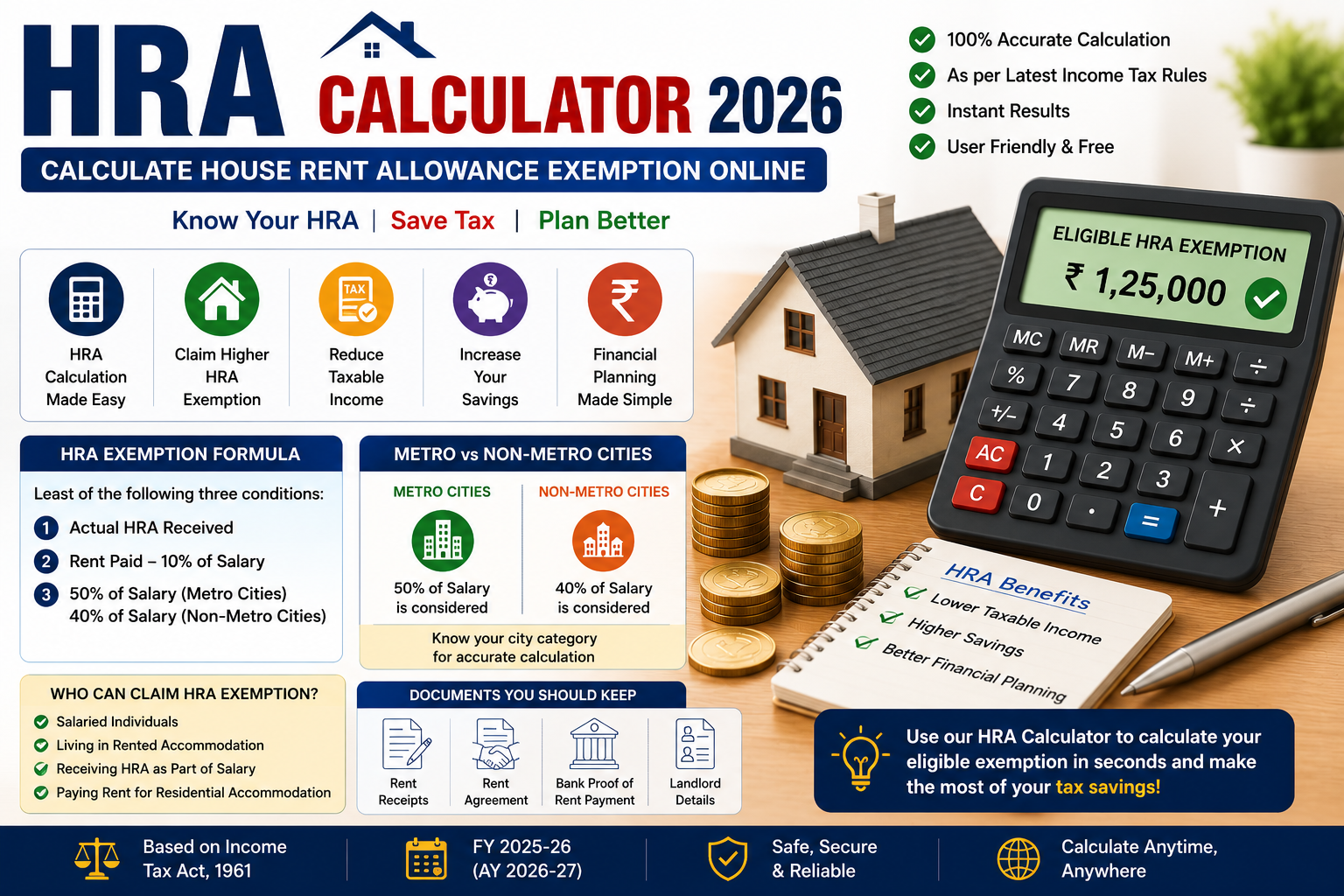
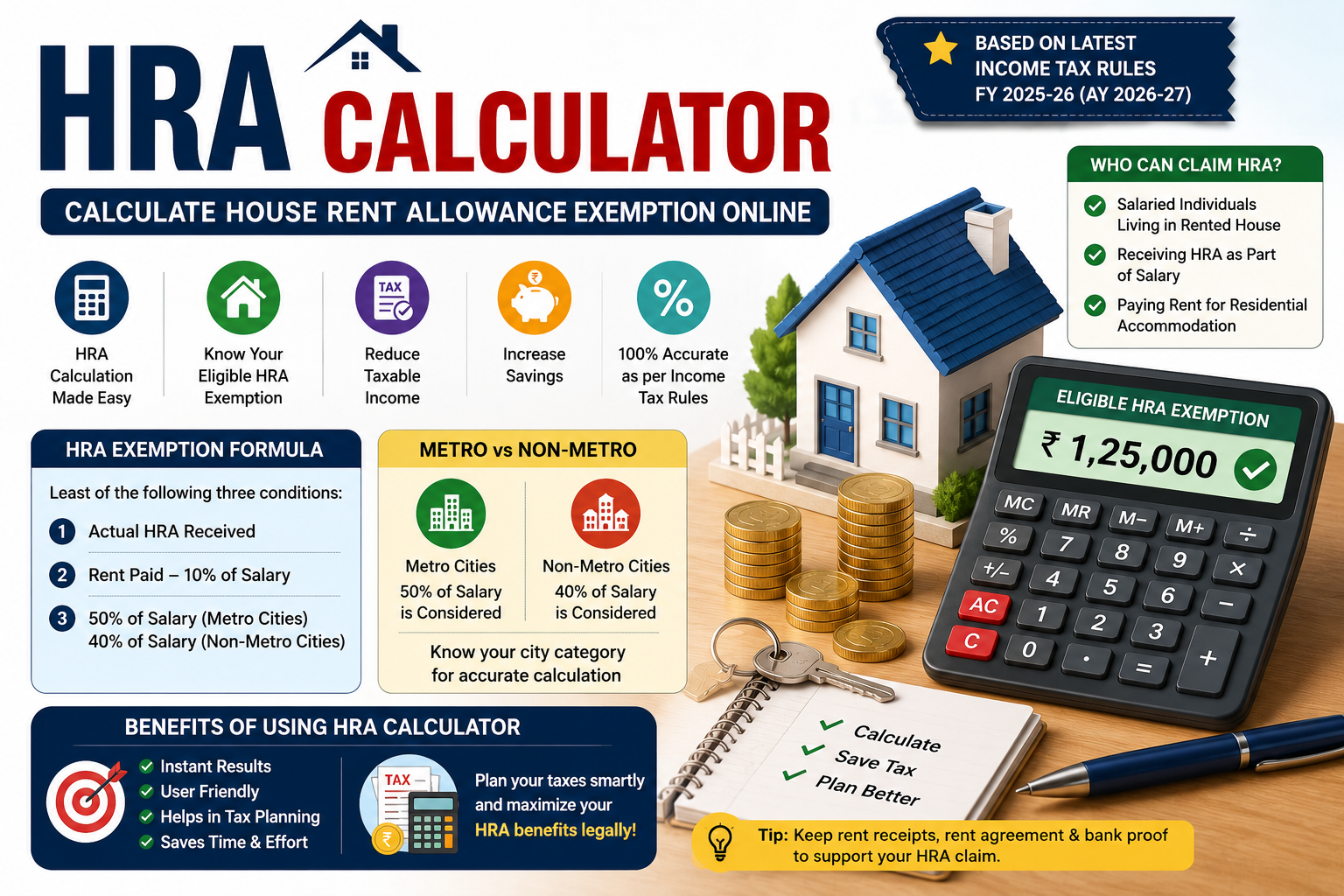
HRA exemption can generally be claimed by salaried individuals who receive House Rent Allowance as part of their salary package and actually reside in rented accommodation.
To claim HRA exemption, employees must typically satisfy certain conditions:
- Receive HRA as part of salary.
- Pay rent for residential accommodation.
- Occupy rented premises.
- Maintain appropriate rent records and supporting documents when required.
Employees residing in self-owned houses generally cannot claim HRA exemption for that same accommodation. Similarly, individuals not receiving HRA as part of salary are generally not eligible for HRA exemption under standard provisions applicable to salaried employees.
Why HRA Calculation is Important
HRA calculation is important because even a small error can affect tax liability significantly. Many employees either underclaim or overclaim HRA exemption due to misunderstanding the applicable formula.
Accurate HRA calculation helps employees:
- Reduce taxable income.
- Estimate monthly tax liability.
- Plan annual tax-saving strategies.
- Compare salary structures effectively.
- Understand actual take-home salary.
- Improve financial planning.
Government employees, railway personnel, defence personnel, PSU employees, and private-sector professionals often rely on HRA calculations while evaluating transfers, promotions, salary revisions, and housing decisions.
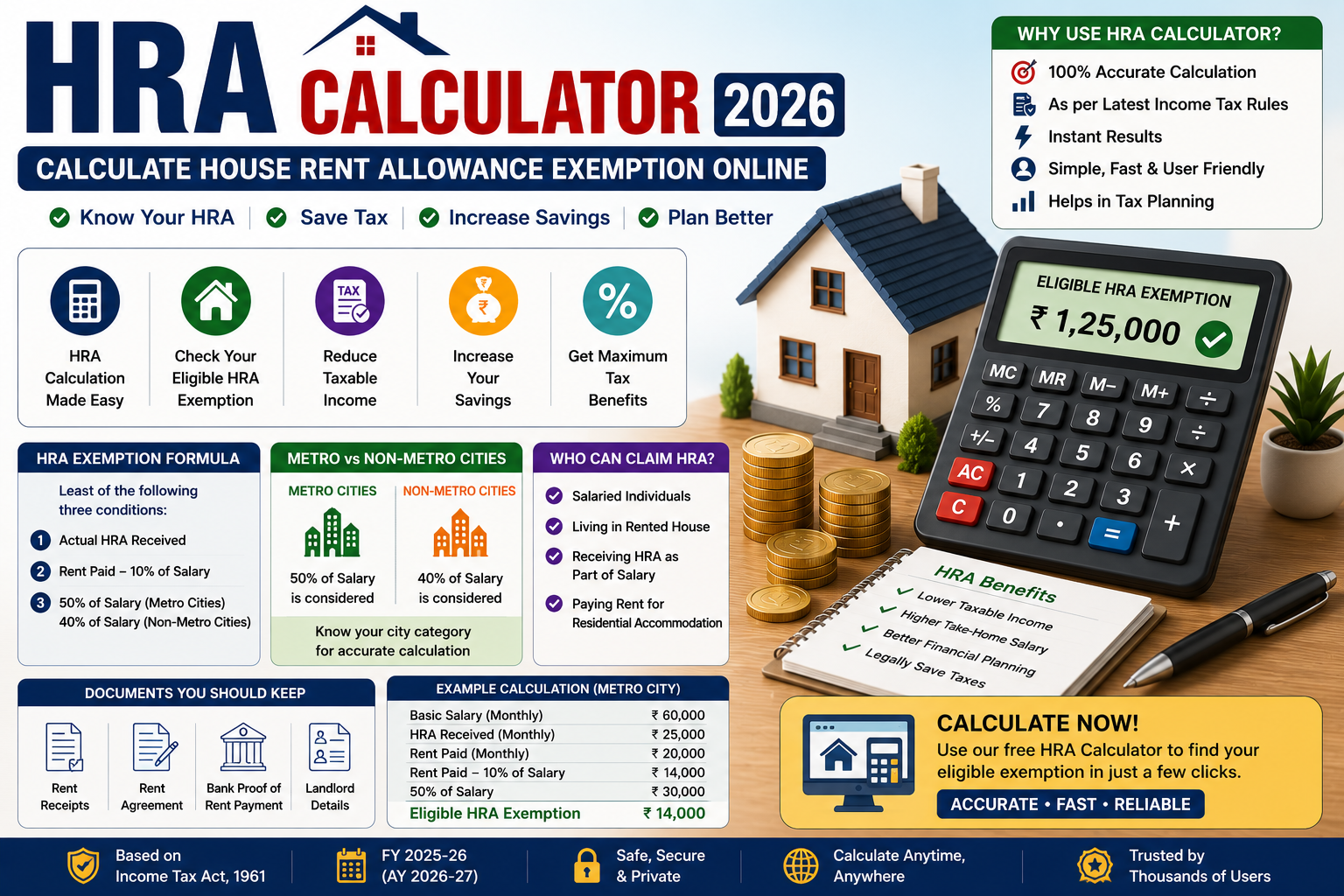
HRA Calculation Formula
The HRA calculation formula used for exemption purposes is based on three separate values. The lowest of these values is generally considered eligible for HRA exemption.
The three values are:
- Actual HRA received from employer.
- Rent paid minus 10% of salary.
- 50% of salary for metro cities or 40% of salary for non-metro cities.
Salary for HRA calculation generally includes Basic Salary and certain qualifying components as applicable under tax rules.
The exempt portion is determined using the lowest value among the above calculations. The remaining amount, if any, becomes taxable.
Understanding HRA Exemption
HRA exemption is one of the most commonly claimed tax benefits by salaried taxpayers under the old tax regime. The exemption reduces taxable income and thereby lowers income tax liability.
The amount of exemption depends upon:
- Salary level.
- Actual HRA received.
- Rent paid.
- City of residence.
- Applicable tax provisions.
Employees living in metropolitan cities often receive a higher exemption ceiling because metro cities generally have higher housing costs compared to non-metro locations.
Difference Between HRA and HRA Exemption
Many employees confuse HRA with HRA exemption. However, both are different concepts.
HRA refers to the allowance paid by the employer as part of salary.
HRA exemption refers to the tax benefit available on that allowance subject to prescribed rules and conditions.
An employee may receive a certain amount as HRA, but only a portion of it may qualify for exemption. The balance amount becomes taxable income.
Metro vs Non-Metro HRA Rules
One of the most important factors in HRA calculation is city classification.
For metro cities, the exemption formula generally considers 50% of salary as one of the comparison limits.
For non-metro cities, the exemption formula generally considers 40% of salary.
This distinction exists because housing costs tend to be significantly higher in major metropolitan locations compared to smaller cities and towns.
Understanding whether your location qualifies as a metro or non-metro city is therefore critical for accurate HRA calculation.
How to Calculate HRA in Salary
Understanding how to calculate HRA in salary is essential for salaried individuals because HRA directly affects taxable income. Although the calculation appears complicated initially, it becomes straightforward once the three exemption conditions are understood properly.
The calculation compares three values:
- Actual HRA received from the employer.
- Actual rent paid minus 10% of salary.
- 50% of salary for metro cities or 40% for non-metro cities.
The lowest of these three figures becomes the exempt portion of HRA. Any amount exceeding the exemption limit becomes taxable income.
For example, if an employee receives ₹20,000 per month as HRA, pays ₹18,000 monthly rent, and has a qualifying salary of ₹60,000 per month, each condition must be calculated separately before determining the exemption.
This is why an automated HRA Calculator is useful because it eliminates manual errors and provides instant results.
HRA Exemption Calculation Example
Consider the following example:
| Particular | Amount |
|---|---|
| Basic Salary | ₹60,000 per month |
| HRA Received | ₹25,000 per month |
| Rent Paid | ₹20,000 per month |
| City Type | Metro |
Step 1: Actual HRA received = ₹25,000
Step 2: Rent paid minus 10% of salary
₹20,000 − ₹6,000 = ₹14,000
Step 3: 50% of salary
50% × ₹60,000 = ₹30,000
The lowest amount among ₹25,000, ₹14,000, and ₹30,000 is ₹14,000.
Therefore, ₹14,000 becomes the monthly exempt HRA amount. The balance HRA becomes taxable.
This example demonstrates why proper HRA calculation is important for tax planning.
HRA Exemption Under Old Tax Regime
The old tax regime continues to allow HRA exemption subject to applicable rules and conditions. Employees who opt for the old tax regime can utilize HRA benefits to reduce taxable income.
For many salaried taxpayers living in rented accommodation, the old tax regime may remain beneficial because it allows:
- HRA exemption.
- Standard deduction.
- Home loan deductions.
- Section 80C investments.
- Various other deductions and exemptions.
Individuals with significant rent payments often find that HRA exemption substantially reduces overall tax liability.
Therefore, HRA calculation becomes an important part of tax planning under the old regime.
HRA Exemption in New Tax Regime
One of the most searched questions today is whether HRA exemption is available under the new tax regime.
The new tax regime follows a simplified taxation structure with reduced exemptions and deductions. Therefore, taxpayers choosing the new regime generally do not receive HRA exemption benefits in the same manner as under the old regime.
This is why many employees compare both tax regimes before making a final decision.
Employees paying high rent in metropolitan cities often evaluate whether the old regime provides greater overall savings due to HRA exemption.
The final choice depends upon salary structure, deductions, investments, housing costs, and overall tax planning requirements.
HRA for Central Government Employees
House Rent Allowance is particularly important for Central Government employees because it forms a significant component of monthly salary. HRA rates for Central Government employees are linked to city classification and are periodically revised based on recommendations and approved government policies.
HRA supports employees who are posted away from government accommodation and must arrange housing independently. Since housing costs vary significantly across locations, HRA rates differ depending upon city category.
Central Government employees frequently monitor HRA announcements because changes in HRA rates directly affect take-home salary.
Future revisions under the 8th Central Pay Commission are also expected to generate considerable interest among employees and pensioners.
Current HRA Rates for Central Government Employees
| City Category | Current HRA Rate |
|---|---|
| X Cities | 27% of Basic Pay |
| Y Cities | 18% of Basic Pay |
| Z Cities | 9% of Basic Pay |
These rates may be revised in the future based on government decisions, Dearness Allowance milestones, and future pay commission recommendations.
Employees should always verify official notifications for current applicable rates.
HRA for State Government Employees
State Government employees also receive House Rent Allowance according to policies adopted by their respective state governments.
Although many states align broadly with Central Government principles, actual HRA percentages, city classifications, and implementation timelines may vary.
Employees serving in state departments often track HRA updates because housing costs continue to rise in urban and semi-urban regions.
Proper understanding of HRA calculation helps state government employees estimate salary benefits more accurately.
HRA for Defence Personnel
Defence personnel often serve in diverse locations ranging from metropolitan cities to remote operational areas. Consequently, HRA assumes special importance whenever government accommodation is not available or when personnel become eligible for housing-related compensation.
Army personnel, Navy personnel, Air Force personnel, and certain defence civilian employees closely monitor HRA policies because housing arrangements vary significantly depending upon posting conditions.
As housing costs continue increasing across India, HRA remains an important factor in overall compensation planning for defence families.
Future developments under the 8th Central Pay Commission may influence HRA-related discussions across the defence community.
HRA for Railway Employees
Indian Railway employees represent one of the largest government workforce groups in the country. HRA plays a major role in their monthly salary structure, particularly for employees posted in urban centers and high-cost locations.
Railway employees often compare city classification, transfer benefits, accommodation availability, and HRA rates while evaluating postings and career progression opportunities.
For employees who do not occupy railway accommodation, HRA can contribute substantially to overall monthly earnings.
HRA and Income Tax Planning
HRA is not merely an allowance; it is also a tax-planning tool. Employees who understand HRA exemption rules can optimize tax savings while remaining compliant with applicable regulations.
Income tax planning using HRA generally involves:
- Maintaining proper rent records.
- Understanding exemption eligibility.
- Selecting the appropriate tax regime.
- Accurately calculating taxable salary.
- Reviewing annual rent expenditure.
A proper HRA calculation strategy can result in meaningful tax savings over the course of a financial year.
Expected Impact of the 8th Pay Commission on HRA
Although no final recommendations are available, discussions regarding the 8th Central Pay Commission have increased interest in future HRA revisions.
Historically, housing-related allowances have remained important components of government salary structures because accommodation costs continue to rise across cities.
Employees frequently expect future reviews of:
- HRA percentages.
- City classifications.
- Pay matrix revisions.
- Salary structures.
- Housing compensation mechanisms.
Any future revision could influence take-home salary, tax planning, and housing affordability for millions of employees and pensioners.
Conclusion
House Rent Allowance remains one of the most important salary components for salaried employees across government, public sector, defence, railways, banking, education, and private industry. Understanding HRA calculation, HRA exemption rules, HRA deduction limits, and tax implications can help employees make informed financial decisions while reducing taxable income wherever legally permitted.
Whether you are a Central Government employee, State Government employee, railway staff member, defence personnel, PSU employee, or private-sector professional, accurate HRA calculation can significantly improve salary planning and tax efficiency. Since housing costs continue to rise in most parts of the country, HRA remains highly relevant for financial management and long-term budgeting.
The HRA Calculator provided below has been designed to simplify the entire process. Instead of manually applying formulas and exemption conditions, you can use the calculator to estimate HRA exemption instantly based on your salary, rent paid, HRA received, and city category. Combined with the explanations and examples provided in this guide, the calculator can help you understand your salary structure more effectively and make better tax-planning decisions.
HRA Exemption Calculator
Use this HRA Calculator to estimate House Rent Allowance exemption based on salary, rent paid, HRA received, and city classification. The calculator automatically applies the standard HRA exemption formula and identifies the eligible exemption amount.
Frequently Asked Questions
1. What is HRA in salary?
HRA or House Rent Allowance is a salary component provided by employers to employees who live in rented accommodation. It helps employees meet housing expenses and may also provide tax benefits under the old tax regime. HRA is commonly offered by government departments, railways, defence organizations, public sector undertakings, banks, and private companies. The actual HRA amount varies depending on salary structure, employer policy, and city classification.
2. What is the full form of HRA?
The full form of HRA is House Rent Allowance. It is a financial allowance paid to employees as compensation for rental accommodation expenses. HRA forms an important part of salary packages because it can contribute significantly to monthly income while also providing opportunities for tax savings under applicable income tax provisions.
3. How is HRA exemption calculated?
HRA exemption is generally calculated using three values: actual HRA received, rent paid minus 10% of salary, and 50% or 40% of salary depending on whether the employee resides in a metro or non-metro city. The lowest of these values becomes the exempt HRA amount. Any remaining HRA is usually taxable.
4. Can government employees claim HRA exemption?
Government employees receiving HRA and residing in rented accommodation may be eligible to claim HRA exemption subject to applicable rules and tax provisions. Eligibility depends upon salary structure, rent payment, and tax regime selection. Government employees frequently use HRA calculations while planning taxes and evaluating housing expenses.
5. Is HRA available under the new tax regime?
The new tax regime generally follows a simplified structure with fewer exemptions and deductions. Taxpayers often compare old and new tax regimes to determine which provides better overall tax benefits. Employees paying substantial rent frequently evaluate HRA benefits before selecting a tax regime.
6. What documents are usually required for HRA claims?
Employees typically maintain rent receipts, rental agreements, landlord details, and related supporting documents. Documentation requirements may vary depending on employer policies, salary structure, and applicable tax provisions. Proper records help support HRA exemption claims during tax filing and verification processes.
7. What is the difference between HRA and rent allowance?
HRA specifically refers to House Rent Allowance included in salary. Rent allowance is often used informally to describe financial support toward housing costs. In salary structures, HRA is the recognized component used for exemption calculations and tax purposes.
8. How does city classification affect HRA calculation?
City classification influences one of the exemption limits used in HRA calculations. Metro cities generally use 50% of salary, while non-metro cities use 40% of salary for comparison. Because housing costs are typically higher in metropolitan areas, exemption limits may also be higher.
9. Why should employees use an HRA Calculator?
An HRA Calculator helps employees quickly determine exemption eligibility without performing manual calculations. It reduces calculation errors, saves time, and provides immediate estimates that support tax planning and salary analysis. Many employees use HRA calculators before filing income tax returns.
10. Is this HRA Calculator suitable for Central Government employees?
Yes. The calculator can be used by Central Government employees, State Government employees, railway personnel, defence personnel, PSU employees, and private-sector professionals. Since it uses the standard HRA exemption formula, it helps estimate exemption eligibility based on salary, HRA received, rent paid, and city classification.
Disclaimer
This HRA Calculator and article are intended solely for educational and informational purposes. HRA exemption eligibility, tax treatment, salary definitions, documentation requirements, and applicable limits may vary depending on prevailing income tax provisions, employer policies, salary structures, and government regulations. For detailed HRA calculations, examples, and exemption rules, readers may refer to our comprehensive HRA Calculator guide.
Users should verify calculations independently and refer to official notifications, tax professionals, chartered accountants, or applicable laws before making financial or tax-related decisions. The calculator provides estimates and should not be treated as legal, financial, or tax advice. Results generated using the HRA Calculator are indicative and should be used only for planning and educational purposes.